
History[edit]
Peel was launched in 2009 by current CEO Thiru Arunachalam[6] and co-founder Bala Krishnan, who serves as chief product officer.[5] Peel built a user base of 25 million during its first few years of operation and then more than tripled to over 70 million in the subsequent year due to agreements with major devices manufacturers Samsung[8] and HTC[9] to include Peel as a preloaded app. Today, Peel has generated over 100 billion remote commands with over 120 million registered users.[10]
Perhaps the voice interface can cut down on the remote commands a few billion or so? If they use Sensory that would be great as it could be a Global audio UX as SENSORY has ALL the languages for MOST of the planet. ( Not Scottish, thats the funny part of Audio UX?).
I really like the China/India & Samsung PEEL efforts.
I am using this first one as a mental model for those that will follow in '17.
Feel free to nominate an APP that lends itself to voice, or really, really needs it. Waze is a good mental model?
Thursday, December 22, 2016
Sunday, December 18, 2016
- New
This one IS a LOT of FUN to read. Consider the implications..... with everything that is at stake in their BIG pic. + Audio UX for PEEL.
Alibaba just takes PEEL out for $$
Why China Just Spent $2.3 Billion On America's Hottest Startups
This story appears in the June 15, 2015 issue of Forbes. Subscribe
Five days before closing a planned $12 million funding round in June 2013, Thiru Arunachalam and Bala Krishnan, founders of remote control app maker Peel, received an unexpected phone call. TransLink Capital, one of Peel's soon-to-be investors, asked them to consider taking an additional $1 million from a Chinese company called Alibaba , a name they barely knew.
"Listen, this is too late in the game," Arunachalam recalls saying, given that it was a Monday and he anxiously wanted to close the deal by Friday. "Let's just leave them alone and move on."
But their suitor would not be turned away. Within 48 hours Alibaba offered to put in $5 million--helping to pump the funding round up to $18.9 million--and sent over a two-page memo explaining its e-commerce business and ambitions in entertainment. By Thursday morning Hongping Zhang, managing director of Alibaba Capital Partners, showed up at Peel's door in Mountain View, Calif. and wooed the two cofounders over a long lunch. That night, already Friday Beijing time, Alibaba shot over the cash.
"They were the last people to talk to us but ended up being the first to wire the money," Arunachalam says. "They moved like a big startup." Less than a year later Alibaba dropped another $50 million into Peel during its Series D round, helping to fund the company as its app grew to more than 100 million users.

ADVERTISING
This investment proved an early and tiny piece of the e-commerce giant's recent spending spree on American startups, one that speaks volumes about a trend quietly reshaping the venture capital ecosystem. Alibaba and its two giant Chinese Internet rivals--search engine Baidu and gaming/messaging firm Tencent--a trio known as BAT, are pouring money into all manner of firms at every stage from seed to late rounds. Since 2012 we count more than 50 investments totaling $2.3 billion. In the past 18 months alone Alibaba has plowed more than $1 billion into just ten U.S. firms.
Many of the investments are bizarre on the surface, smacking of dumb money rushing in late in the cycle and driving up valuations for everyone. Why would an e-commerce giant spend tens of millions of dollars on a startup like Peel that's outside of its core business, not to mention its core country?
In a word: smartphones. The three BAT companies each monopolize a sphere of China's desktop-style online behavior, but they risk falling behind in mobile. This is a problem in a country where tens of millions of people skip PCs entirely. Hence the landgrab--the Big Three don't much care where the innovations on this new intertwined platform come from or, it seems, how much they have to shell out to secure them.
"In the online world, everybody has their own domain, but in mobile, everyone's competing on everyone else's turf," says Jay Eum, cofounder of TransLink Capital, the venture capital firm that introduced Alibaba to Peel and has invested in two other Alibaba-backed startups, Quixey and Tango.
To some extent it's similar to the concurrent multifront competition in the U.S. among Amazon, Google GOOGL -0.75% and Facebook, and each of the three Chinese companies brings its own style. Tencent is the most quiet about its investments, reflecting the low-profile personality of its billionaire founder, Ma Huateng. Baidu focuses on research investment as well as direct funding in startups, a hybrid style similar to that of its U.S. inspiration, Google. The company is sinking $300 million into an R&D lab in Sunnyvale, Calif., the largest yet by any Chinese Internet company in California, run by Andrew Ng, cofounder of online educator Coursera and the man who set up Google's deep learning project.
Meanwhile, Alibaba's venture unit operates much like its largest outside shareholder, Masayoshi Son's SoftBank. "There's always a strategic angle, but a certain level of investment returns is the bottom line," says TransLink's Eum. Alibaba's Jack Ma saw how much SoftBank and Yahoo made from investing early in his firm--now he wants his own lottery ticket.

Bala Krishnan (left) and Thiru Arunachalam, cofounders of app maker Peel, barely knew Alibaba when the Chinese e-commerce giant offered to invest. (Eric Millette For Forbes)
The competition among the three plays out in ways that often don't seem rational. Last December Baidu's chief financial officer, Jennifer Li, right-hand woman to its billionaire CEO, Robin Li, helped lead Baidu's roughly $200 million investment in Uber at a reported $41 billion valuation. A search engine buying into a car-hailing app doesn't make a ton of sense on paper. No matter, says Li: "Mobile development in China is exploding. Baidu's vision today is to connect people with services. Uber is an example of that."
Plus, she needed to respond to her two rivals. As Uber set foot in China, Tencent and Alibaba were already backing two Uber clones, Didi Dache and Kuaidi Dache, respectively. Now the Chinese can hail Uber on their phones through Baidu Maps. The search engine is also hoping to leverage Uber in Baidu Wallet's uphill battle against Alibaba's Alipay and Tencent's WeChat Payment. Not to be outflanked, Tencent and Alibaba merged their ride-share shops, creating a near monopoly worth $8.75 billion. And the battle rages on.
Kevin Chou could do that math. The CEO of San Francisco-based mobile-gaming startup Kabam hit the road in China for his latest funding round last spring, hopeful for access to that market. "Entering China is a pretty complicated affair," he says. "It operates in a very different fashion than any other market in the world because of such a strong presence of the major Chinese Internet players." For the next few months the 35-year-old Chinese-American, who cofounded his company in downtown Mountain View above a dim sum restaurant, sought out the BAT trio, among others, and ended up with five term sheets. "It's a lot of dinners, a lot of baijiu ," grins Chou, referring to a potent Chinese liquor.
By July Kabam had its number--a valuation that shot it past the $1 billion "unicorn" threshold--from Alibaba, which plunked down $120 million for just over a 10% stake, as well as instant credibility and relationships in China. "If you don't know who you're working with, you can really get yourself into trouble," says Chou.
Alibaba, for its part, paid the premium with a clear eye on Tencent, the world's largest gaming company, which has $7.2 billion in revenue from online gaming alone last year. The deal came with an initial commitment by Kabam to launch ten games during the next three years through Alibaba, including ones related to Hollywood blockbuster movies like Lord of the Rings , Hunger Games and Fast and Furious . Expect Alibaba to leverage its investment by using its PayPal clone, Alipay, for mobile micropayments and by promoting Kabam through the Alibaba-backed video site Youku Tudou.

Kabam CEO Kevin Chou had his pick of Chinese money and took Alibaba’s $120 million plus its promise to help him crack China’s market. (Timothy Archibald for Forbes)
"While they care about the financial returns, the amount of money they put into Kabam is a rounding error," says Chou. "They don't stress out anytime when there's a small problem." Alibaba even organizes an annual "Ali-family" party for its portfolio companies with the hope of fostering synergies. San Mateo-based ShopRunner, which raised $206 million from Alibaba in 2013, was one of the first partners of Alipay's ePass program, which enables U.S. retailers to sell directly to Chinese consumers. "It came up afterwards, after we started to understand more about each other," CEO Scott Thompson says. "Now it's obvious that there's something else we can do together, and it's likely to be a really interesting big business at some point."
Such synergies (and enormous valuations) make the BAT troika today's investors of choice. Silicon Valley used to look askance at money coming from a place where the central government blocks everything from Facebook to Gmail. "When Alibaba first invested, we took it with a huge grain of salt," says Peel's Krishnan. Now companies like Snapchat look eagerly to China--the disappearing-message app is reportedly raising $200 million from Alibaba, which again seems to be targeting Tencent, specifically its WeChat service. No matter that Snapchat is banned in China (or that Tencent also invested in a 2013 round).
"They're playing a global game of domination on the Internet," says Patrick Riley, founder and CEO of search engine Ark, for which Tencent participated in a $4.2 million seed round. "It goes entirely against the reputation, what the United States thinks of Chinese companies, which is just copy-paste." With BAT leading the trend, other tech companies, from mobile giant Xiaomi to Baidu rival Qihoo, are following in their footsteps with smaller deals. With the right bets in Silicon Valley, Chinese companies can redeploy the U.S. startups' technology and talent for their immediate next steps: expansion into other emerging economies such as India and Brazil. Eventually they'll grab a piece in the saturated American market.
"Everyone is competing on everything," says Kabam's Chou. Advantage, entrepreneurs.
Audio UX looms large for China. We want the PEEL integration to be GLOBAL....China/India.
If it works really well imagine how a device starts to be different that one that does NOT have this Voice PEEL?


Saturday, December 17, 2016
" Hello Blue Genie"
Can you run this info through your FPGA inference engines for us?"
"You bet jfieb,..."
" Notice that with a software app partner, like PEEL, that the adjacent possible changes just like that. They have a solid presence in India and China and some strong partners.
Notice HOW the adjacent possible need not be some 5 x10 foot broom closet, but it can be a beautiful gala ballroom just as easily."
I learned this part today...
http://economictimes.indiatimes.com...ion-labs-rd-division/articleshow/49089227.cms
Silicon Valley based Peel acquires Fission Labs R&D division
By ECONOMICTIMES.COM | Updated: Sep 24, 2015, 03.06 PM IST
Post a Comment
READ MORE ON » Xolo | Tata Sky | silicon valley | Narendra Modi | Kishore Poreddy | Karbonn | HTC
Days before the much-anticipated visit by India's Prime Minister Narendra Modi to the Silicon Valley to focus on supporting innovation & technology in India, Silicon Valley based Peel, a smart remote maker, has announced they are acquiring the Cloud R&D division of Hyderabad-based Fission Labs which will now become Peel India. With a three-year sales growth of
Alibaba-funded Peel ranked 287 among the Inc. 5000 list of America's fastest-growing private companies this year.
< ..
Read more at:
http://economictimes.indiatimes.com...ofinterest&utm_medium=text&utm_campaign=cppst
PEEL may have an announcement for CES, also they have been busy in BaRCELONA in yrs past.
\
Peel Smart Remote App Revamp Showcases YouTube and India-Centric Content
Manish Singh, 18 December 2015
Share on FacebookTweetShareShareEmailReddit
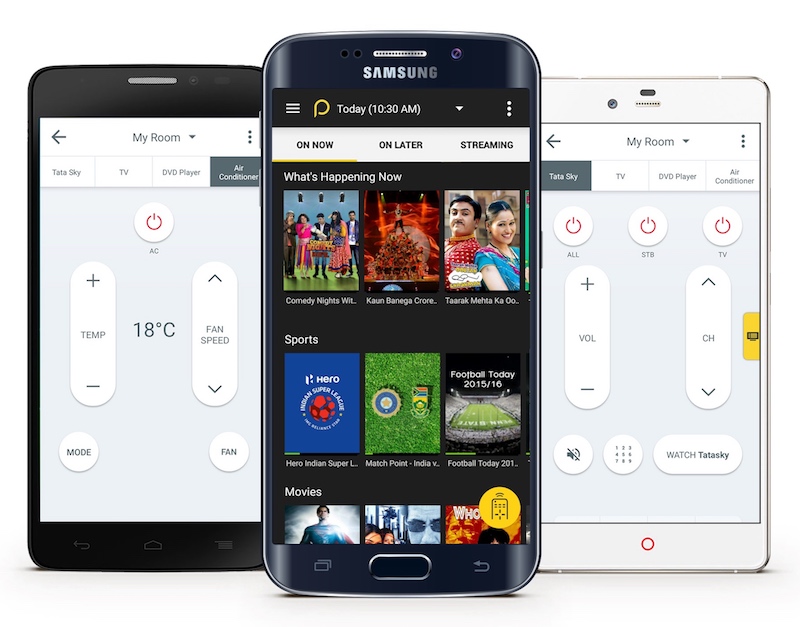
Peel, a smart home control and television tune-in player, has redesigned its user interface with a recent update to add support for YouTube streaming channels. The redesign aims to make it easier for users to discover content right on the home screen. The app now taps on both TV listing of your local operator and streaming content libraries to show you results. Peel also plans to give recommendations on a user's past TV viewing behaviour.
Peel Smart Remote, which already supports a large pool of Indian set top box services including Airtel,Tata Sky, Dish TV, Hathway, and DEN, announced on Friday that it is adding more features aimed at Indian users. Starting with Peel v6.1 on Android (handsets that have an IR sensor), users will be able to find content from YouTube and keep up with their favourite channels. The integration now allows users to find Indian movies and TV shows available on YouTube.
The company also announced plans to launch 45 CatchUp TV series, which will be available in a number of Indian regional languages. The company told Gadgets 360 that it is currently negotiating with content players in the country.
Peel confirmed to us that iPhone users will not be able to utilise the new feature, as they are required to possess a separate device called Pronto, which isn't available in India yet. Peel plans to launch Pronto in the country in the coming months.
NOtice anything?
QUIK has added CyWee motion and PEEL has a focus on India. The stuff we have tightly integrated starts to make it easy to go Eos?
I wonder how many languages PEEL will start with? Its not so important as yhey will just expand from a core into the adjacent ones.
"Our goal has always been to make the experience of consuming video entertainment easier and more enjoyable," said Peel CEO and Co-Founder Thiru Arunachalam. "As more and more of our users diversify their entertainment consumption to include streamed content, it makes sense for us to simplify their journey to find something good to watch no matter what the source or destination is."
Peel currently has more than 135 million registered users and is actively partnering with Indian smartphone manufacturers and some that sell handsets here to preload its app on their devices. Some of these manufacturers include Karbonn Mobiles, Xolo, Gionee, Panasonic, and Celkon.
Smart Remote App Peel Technologies Expands in Asia

By
LORRAINE LUK
Jan 9, 2015 2:32 am ET
0 COMMENTS
Peel smart remote control application on select smartphones
PEEL TECHNOLOGIES
U.S.-based smart remote control application Peel Technologies is gearing up for global expansion after securing funding from Chinese Internet giant Alibaba.
The company, which raised $5 million from Alibaba in 2013 and closed a second round of funding of $50 million in June, has acquired a Shanghai-based rival Mozitek for an undisclosed sum to jump start its efforts in China, the country with over 1.2 billion mobile users.
The Peel smart remote control application, which can is installed on select smartphones, uses an infrared blaster in order to communicate with anything that uses a remote control including TVs, set top boxes and air conditioners.
Some hardware manufacturers integrate Peel’s infrared software in their phones, eliminating the need for certain chips to manage the infrared blaster, reducing costs, space required and energy usage, according to Thiru Arunachalam, a former product manager at Apple who co-founded Peel in 2009.
The Peel smart remote control, which has over 118 million active users, is also expanding its presencein India by forming partnerships with local phone makers including Spice,Celkon and Lava Xolo.
In an interview with The Wall Street Journal, Peel Co-founder and CEO Arunachalam discusses the company’s strategy and expansion plans. Edited excerpts:
WSJD: What is your approach to the China’s market?
Arunachalam: Peel has always been a global first, mobile first company. China was always considered as one of the important global markets for us to conquer because it has a large and growing consumer base for smartphones and there are so many fast-growing Chinese smartphone vendors with global aspirations. We studied what Google did in China before entering the market. Some foreign companies actually tried to take their products and force theminto China. But Peel has adopted a local strategy. We are different from Google who sent their U.S. engineers to China. We acquired a local smart remote control company, Mozitek, to take advantage of the company’s localized products and existing sales relationships with Chinese hardware makers. Mozitek’s CEO has become Peel’s head of sales for China. I want the local team to operate independently with its own line of Chinese products and clients.We also have teamed up with Chinese hardware makers ZTE and TCL as they know the local consumer behavior.
WSJD: What are your growth targets for China’s market?
Arunachalam: We are now focusing on growing our users in China first before thinking of making money. In the U.S. market, we only started monetizing our application in the fourth-year of operation. We will continue to beef up our team in China and we aim to have 100 million users in the country by 2016. U.S. is a small country compared to China and Latin America. Currently, 35% of our users are from North America, 30% are from Asia and 25% come from Europe.I expect our user distribution will change as China’s market will continue to grow. China is great for us as many Chinese hardware makers also manufacture devices for India, another important market in Asia.
WSJD: How would Alibaba help Peel’s expansion in China?
Arunachalam: Alibaba is currently helping with strategic advice regarding developing relationships with Chinese hardware manufacturers, distribution partners and local acquisitions, as well as assisting with introduction to potential business development and marketing partners. To date, Alibaba has taken a relatively hands-off approach to its investment, encouraging Peel to focus on consumer experience and rapid growth rather than revenue.
WSJD: Would Alibaba’s investment affect your potential cooperation with other major Chinese Internet companies?
Arunachalam: Commercial cooperation is not a problem. There is no reason that we cannot work with Tencent and other Chinese Internet companies. In fact, we are working with Chinese search engine Baidu to promote our customized shareable URL links that let users tune in directly to TV shows. Peel will also partner with China’s Twitter-like social platform Sina Weibo to reach more users in the country.
WSJD: Is Peel in talks or looking to acquire more technology companies in China and Asia?
Arunachalam : Yes, we are keeping an eye out for potential synergistic companies to acquire. Peel currently has sales offices in both South Korea and India.
WSJD: What do you think of competition with other smart remote control applications?
Arunachalam: We know the customers and we already have millions of users. I doubt if other rivals can catch up as we have scale. We also have patents to protect our technology
The Adjacent Possible starts to show with every one of these software deals we read of.
You should be happy about the China/India adjacent possible.
- New
PEEL owns this CHina co.
Company Overview of MOZITEK Inc.
Snapshot
People
Company Overview
MOZITEK Inc. operates a multi screen platform that offers an electronic program guide (EPG) data center and data services to its users. The company is based in Shanghai, China. As of June 12, 2014, MOZITEK Inc. operates as a subsidiary of Peel, Inc.
Get used to this... PEEL has IoT ambitions, they have been a China a nice amount of time and know some very HUIGE names there. TENCENT has 750 million immersed users.
China doesn't want the touch screen for input.
Also, I got to REACTIVATE this folder, all that work we did was it really a waste of resources or will it b worth it.......
consider that it was not wasted at all. We will get to use that effort and add to it when we read about the new way the app works.
I really like the CHina angle as you add CyWee into the mix......
Friday, December 16, 2016
It only says TV, but PEEL sees IoT in their adjacent possible
Microsoft Cortana Leverages Peel for Smart Home Solution
19 04 , 2016No CommentsShare
 Microsoft Cortana has partnered with Peel to leverage the company’s home intelligence along with our 150M connected homes to make Proactive Assistant-enabled smart home a reality. The Peel-Cortana collaboration was demoed this past week at the Microsoft Brand conference, and will be available for download to Windows Mobile phones soon. Among other things, the Peel Smart Remote has integrated with some of Cortana’s features, including location awareness, to generate on-the-fly, contextually aware intelligent home control suggestions.
we can see where it leads
PS.. The conclusion was PEEL?
A waste of time that went nowhere. It seems that might not B accurate? tracking along...
PEEL has reason to want Voice...well beyond TV channels?
Microsoft Cortana Leverages Peel for Smart Home Solution
19 04 , 2016No CommentsShare
Microsoft Cortana has partnered with Peel to leverage the company’s home intelligence along with our 150M connected homes to make Proactive Assistant-enabled smart home a reality. The Peel-Cortana collaboration was demoed this past week at the Microsoft Brand conference, and will be available for download to Windows Mobile phones soon. Among other things, the Peel Smart Remote has integrated with some of Cortana’s features, including location awareness, to generate on-the-fly, contextually aware intelligent home control suggestions.we can see where it leads
PS.. The conclusion was PEEL?
A waste of time that went nowhere. It seems that might not B accurate? tracking along...
PEEL has reason to want Voice...well beyond TV channels?
Subscribe to:
Posts (Atom)