A repost from pmcw that I want to reread again.
For casual readers.. I have read the very hard to work on material of Richard Thaler.
WHo is he you might ask?
https://en.wikipedia.org/wiki/Richard_Thaler
He created his field..behavioral finance. It is NOT an easy read, but he did write about SIGNAL and NOISE. For me it fits into Metcalfe's law about a network...
it fits into our current cultural discussions around say Russia; news and Fake news. There IS SIGNAL and there IS noise. It is possible to tell the difference?
For some maybe NOT, for me I take Thaler to heart...IF you have the right algorithm to filter the noise out the distillation is better than what you would get IF there were no noise at all.
So I live with the idea that noise IS GOOD. In my professional job, it is what I DO. Throw away noise and act on a signal...not easy, but vitally important.
Much of the anxiety of owning a meaningful amount of QUIK is NOISE. Anxiety= A NOISE generator? You may need to share your anxiety, and it IS very contagious, worse than the Infuenza of the early 20th century- but is it signal or noise. It is mostly noise. So I have an internal algo for anxiety....read a lot. and if its not gone....read some more.
So with this in mind here is the post I am not just rereading- I am STUDYING it....it is an IMPORTANT signal....
-
New
PMCW wrote this...
Let me share some of my thoughts regarding the new design win QUIK presented with the app company that has initiated a products group.
Google is usually thought of as an advertising company. I wrote some years back a better way to view Google is as an information company.
The reason why Google and so many other companies "give" valuable stuff away is the stuff collects information that gives these companies leverage. Selling direct advertising is one way to leverage this information, but facilitating access to markets or information about markets is a more accurate way to look at it.
App companies do the same thing. They give away apps and collect personal information from app users. The ultimate apps are interactive (more and better information) - and the stickiest are those with social aspects (interactive + builds emotional ties).
Successful software app companies measure installed bases in hundreds of millions, which gives them branding power and a point of presence with a qualified potential customer base that attaches some value to that branding.
While these companies are masters at leveraging the information they collect from users, they are not directly leveraging the market pipe that goes in the other direction beyond selling, often indirectly, that privilege to others. This means these companies have an un-leveraged pipe to a qualified market, and if leveraged right, the potential to add ecosystem leverage to the model.
This is why some of the smarter app companies are exploring the products business. Some of them will likely sell products for profit, but I think most of them will use products to build out ecosystem business models that puts the profit in the middle. The implication here is these companies will likely price products to optimize volume.
In other words, I have no idea if this or any other given product introduced by the app companies moving into the hardware arena will be successful, but the mechanics of the business model give these companies access to a huge markets where they already have branding value.
Bottom Line: These companies are masters at leveraging information. The more personal (more identified to a person) the information the higher the value. Interaction drives value, and interaction is natural with anything physical (products are physical). Lots of motivation for these companies to play hard.
-
New
lets add in some incremental info..this IS the SIGNAL?
The economist.........May 6 - 12. The editorial...
The worlds MOST valuable resource.
5 stars. they say it very well. I will print it and read it and use it as a CORE SIGNAL. What does the CORE signal say, if you can discern it forget what anyone else says. I HAVE NO opinion, but a CORE signal has one and it is the only one that matters?
-
New
the link...
http://www.economist.com/news/leade...antitrust-rules-worlds-most-valuable-resource
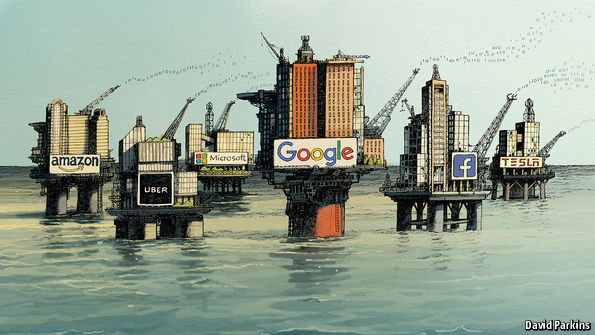
Regulating the internet giantsThe world’s most valuable resource is no longer oil, but data
The data economy demands a new approach to antitrust rules
Print edition | Leaders
May 6th 2017
A NEW commodity spawns a lucrative, fast-growing industry, prompting antitrust regulators to step in to restrain those who control its flow. A century ago, the resource in question was oil. Now similar concerns are being raised by the giants that deal in data, the oil of the digital era. These titans—Alphabet (Google’s parent company), Amazon, Apple, Facebook and Microsoft—look unstoppable. They are the five most valuable listed firms in the world. Their profits are surging: they collectively racked up over $25bn in net profit in the first quarter of 2017. Amazon captures half of all dollars spent online in America. Google and Facebook accounted for almost all the revenue growth in digital advertising in America last year.
Such dominance has prompted calls for the tech giants to be broken up, as Standard Oil was in the early 20th century. This newspaper has argued against such drastic action in the past. Size alone is not a crime. The giants’ success has benefited consumers. Few want to live without Google’s search engine, Amazon’s one-day delivery or Facebook’s newsfeed. Nor do these firms raise the alarm when standard antitrust tests are applied. Far from gouging consumers, many of their services are free (users pay, in effect, by handing over yet more data). Take account of offline rivals, and their market shares look less worrying. And the emergence of upstarts like Snapchat suggests that new entrants can still make waves.
See all updates
But there is cause for concern. Internet companies’ control of data gives them enormous power. Old ways of thinking about competition, devised in the era of oil, look outdated in what has come to be called the “data economy” (see Briefing). A new approach is needed.
Quantity has a quality all its own
What has changed? Smartphones and the internet have made data abundant, ubiquitous and far more valuable. Whether you are going for a run, watching TV or even just sitting in traffic, virtually every activity creates a digital trace—more raw material for the data distilleries. As devices from watches to cars connect to the internet, the volume is increasing: some estimate that a self-driving car will generate 100 gigabytes per second. Meanwhile, artificial-intelligence (AI) techniques such as machine learning extract more value from data. Algorithms can predict when a customer is ready to buy, a jet-engine needs servicing or a person is at risk of a disease. Industrial giants such as GE and Siemens now sell themselves as data firms.
This abundance of data changes the nature of competition. Technology giants have always benefited from network effects: the more users Facebook signs up, the more attractive signing up becomes for others. With data there are extra network effects. By collecting more data, a firm has more scope to improve its products, which attracts more users, generating even more data, and so on. The more data Tesla gathers from its self-driving cars, the better it can make them at driving themselves—part of the reason the firm, which sold only 25,000 cars in the first quarter, is now worth more than GM, which sold 2.3m. Vast pools of data can thus act as protective moats.
Access to data also protects companies from rivals in another way. The case for being sanguine about competition in the tech industry rests on the potential for incumbents to be blindsided by a startup in a garage or an unexpected technological shift. But both are less likely in the data age. The giants’ surveillance systems span the entire economy: Google can see what people search for, Facebook what they share, Amazon what they buy. They own app stores and operating systems, and rent out computing power to startups. They have a “God’s eye view” of activities in their own markets and beyond. They can see when a new product or service gains traction, allowing them to copy it or simply buy the upstart before it becomes too great a threat. Many think Facebook’s $22bn purchase in 2014 of WhatsApp, a messaging app with fewer than 60 employees, falls into this category of “shoot-out acquisitions” that eliminate potential rivals. By providing barriers to entry and early-warning systems, data can stifle competition.
Who ya gonna call, trustbusters?
The nature of data makes the antitrust remedies of the past less useful. Breaking up a firm like Google into five Googlets would not stop network effects from reasserting themselves: in time, one of them would become dominant again. A radical rethink is required—and as the outlines of a new approach start to become apparent, two ideas stand out.
The first is that antitrust authorities need to move from the industrial era into the 21st century. When considering a merger, for example, they have traditionally used size to determine when to intervene. They now need to take into account the extent of firms’ data assets when assessing the impact of deals. The purchase price could also be a signal that an incumbent is buying a nascent threat. On these measures, Facebook’s willingness to pay so much for WhatsApp, which had no revenue to speak of, would have raised red flags. Trustbusters must also become more data-savvy in their analysis of market dynamics, for example by using simulations to hunt for algorithms colluding over prices or to determine how best to promote competition (see Free exchange).
The second principle is to loosen the grip that providers of online services have over data and give more control to those who supply them. More transparency would help: companies could be forced to reveal to consumers what information they hold and how much money they make from it. Governments could encourage the emergence of new services by opening up more of their own data vaults or managing crucial parts of the data economy as public infrastructure, as India does with its digital-identity system, Aadhaar. They could also mandate the sharing of certain kinds of data, with users’ consent—an approach Europe is taking in financial services by requiring banks to make customers’ data accessible to third parties.
Rebooting antitrust for the information age will not be easy. It will entail new risks: more data sharing, for instance, could threaten privacy. But if governments don’t want a data economy dominated by a few giants, they will need to act soon.
Please become a real NODE on a network... we need to discuss this, NOT other stuff. This is the signal. IF we figure it out we are the conquistadores in a much kinder way, we are the oil barrons,
So with this great essay on your minds read pmcw again. Why software NEEDS hardware... they NEED the data and they need it ASAP? If you GET that data you have something............
and if its useful data you have MORE value.
Up from the basement archive for rereading this Sunday am...
1 yr ago..perhaps it was for good reason they had several job opening there :-)
You know SEC....
Samsung Electronics Co., Ltd. ("SEC") was incorporated under the laws of the Republic of Korea to manufacture and sell semiconductors,
So we know they are a very good and hopefully much better customer.
But LG?
Why do I ponder this you ask?
Own and manage relationships across multiple levels (SVP to engineering teams) at SEC and LG (SEC priority) and multiple organizations (HW, SW, MM, Procurement, other)
this snip...
Drive execution post-dwin to MP, managing local teams and HQ engagements.
does post- dwin mean post design win? to MP? anybody know what that is?
Hey QUIK do you have a dwin at LG?
Maybe its a typo or poor translation?
have to have some fun, it would be really nice to have LG as a customer
-
-
THis snip...
QuickLogic is bullish about a market for using Alexa to add voice control to systems using the EOS sensor hub it started shipping in November. So far three smartphones, one wearable and one IoT device are using the chip.
3 Smartphones?
1.
2.
3.
13 Apr. 2017 SMIC Advanced Technology Workshop Shanghai, Chinadone18 Apr. 2017 SMIC Advanced Technology Workshop Santa Clara, CA, USyesterday and onward to9 May. 2017 SMIC Advanced Technology Workshop Hsinchu, TaiwanHsinchu is a city in northern Taiwan, southwest of the capital city of Taipei. It’s known for its ornate Hsinchu City God (Cheng Huang) Temple, lined with food stalls. Close by is Yin Hsi East Gate, a 19th-century structure once used as an entrance to the city. Hsinchu Zoo houses hippos, Bengal tigers and Malay bears. Southeast of the center, trails cross the forested Shibajian (18 Peaks) Mountain.QUIK is the traveling gnome of eFPGA?As a part owner I like these sort of postcards! This company is small, but very global, I like these tech road shows as a part owner A LOT more than I like those aimed at the street-like the Roth type ones: but .....to each there own,
-
-
So consider that from 40 to 22 gives us 60% of new area...
And then to 12 another 50% after that.
So as a part owner of this business being on the RIGHT side of Moore's law is fun, the anxiety of watching an AP suck up the great Apical algo is banished thankfully for good. QUIK will add more engines toward that word heterogeneous computing. Only IF it is ubiquitous will it get hardened...
A FEW APP companies are HUGE enough to have proprietary engines of their own?. say
Flexible Facebook engine, to partition within the SoC.
I also believe technologies / companies signed up for FDXelerator will be available on 12nm FDX too.

Why do I reread this often?
This week I am NOT looking at it from my small point of view, but pretending I am a Tier 1 MAJOR app company with a new product division who has a vision of the future... I WOULD NOT use anything that did NOT scale toward that horizon....
Now QUIK CAN use 22 and then 12 to add a LOT of stuff ... the SoC for that ultimate vision can barely be glimpsed from the rooms that QUIK has just entered, after waiting a long time for the invite.
Use any incremental info to let it sink in that QUIK IS worth a LOT more today than ever before.

